“I have such a ball in my classes, and I learn so much from my students. They probably don’t realize that I come to school here, too. I’m just the oldest member of the class. I just wish everyone could experience the blessing of learning new things all the time.” Barry Harris

Now available to stream online through an annual subscription.
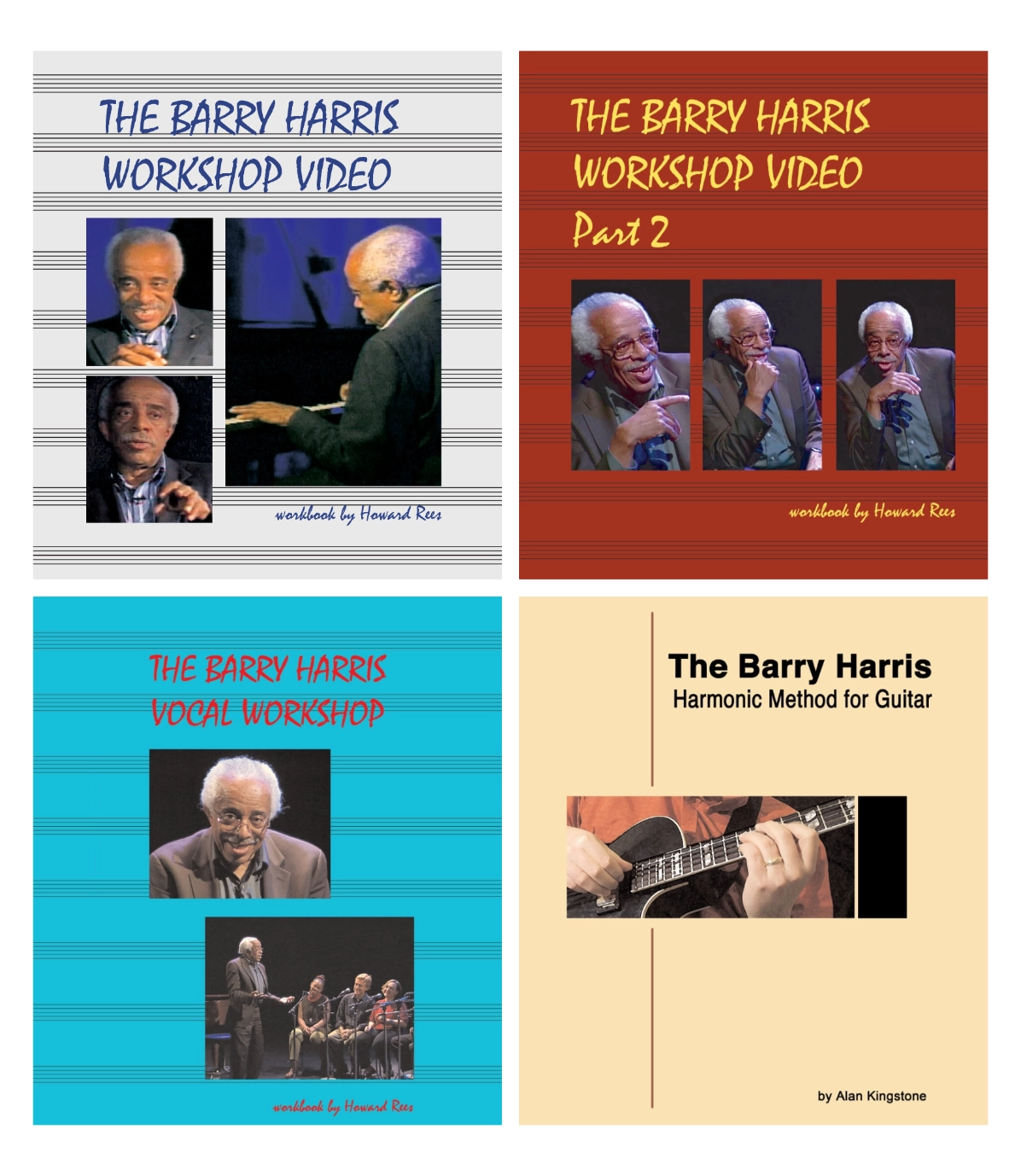
As in all of his creative pursuits, Barry’s quest to develop, expand and share this part of his work is tireless. Almost ten years after the completion of our original ‘Workshop Video’, it made sense to document a new wealth of information and nuance in a second volume.
Shot in a ‘clinic setting’, this beautifully filmed session is approximately 4 hours, 15 minutes in length, and features great overhead views of Barry at the piano. The accompanying 156-page workbook includes a transcription of all the musical examples.
The Barry Harris Workshop Video Part 2 highlights the following three chapters:
Improvisation
Intended for instrumentalists and vocalists, this 1st session presents Barry’s latest thoughts on chord and scale relationships; feeling the rhythm of a line; scale practice including expanded ‘Extra Note Rules’; how to apply ‘extra notes’ to any scale or grouping of notes; the use of surrounding notes; developing ‘turnbacks’; in-depth line building work on ‘rhythm changes’ – and more.
The Rhythm Section
This session is vital for all rhythm section players and stresses the importance of using ‘upbeats’ as they apply to each instrument; ‘feeling 6’ while playing in 4/4; the usefulness of playing small chords voicings; Barry’s voicings for the Blues, ‘rhythm changes’ and more.
Harmony
Long-awaited, this session gets right to the heart of Barry’s unique harmonic system. Detailing ‘sixth diminished’ chord theory, chord movement, and putting together effective voicings, this section is highlighted by Barry’s performance of “I Should Care”, featuring great overhead camera shots.
Piano and guitar transcriptions are included.
About Barry Harris
 “I guess you could say Barry Harris is one of the very last of the bebop purists that we have on piano. He is a living and brilliant extension of Bud Powell.”
Walter Bishop Jr.
“I’ve always thought that if Charlie Parker had played piano, he would sound exactly like Barry Harris. Or is it the other way around? In any case, Barry’s sense of time, motion and rhythm is absolutely impeccable.”
Benny Golson
“A list of Harris’ graduates reads like a Who’s Who of Jazz; among them are Paul Chambers, Curtis Fuller, Joe Henderson, Lonnie Hillyer, Yusef Lateef, Hugh Lawson, Kirk Lightsey, Charles McPherson, and Doug Watkins.”
“Harris’ (method) is unique in both its emphasis and detail, for it teaches students precisely how to transform the (basic theoretical) elements into credible phrases and focuses as much upon the creative processes of improvisation as upon its products, effectively clarifying the relationship between theory and performance practice in the jazz tradition.”
“Harris’ theory is an expansive generative method. It encourages musicians to create original phrases based, in part, on the cross-fertilization of rhythmic, melodic, and harmonic models embodied in the rules Harris promulgates.”
Excerpts from ‘Thinking in Jazz’, by Paul F. Berliner, University of Chicago Press 1994
Table of Contents
Chapter 1
(Chapter 1) Improvisation
- The Chromatic Scale
- The Two Whole Tone Scales
- The Three Diminished Chords
- The Four ‘Related Dominant 7th Chords’
- The Diminished Scale and Usage
- Running the Four Related Dominant 7th Scales into Each-Other
- Use of ‘Surrounding Notes’
- Going from IV – I
- ‘Feel the Shape of the Melody’
- “Scrapple From The Apple” (excerpt) by C. Parker
- Phrase Building on ‘Rhythm Changes’
- ‘Turnbacks’ Using: Scale Degrees; Related Diminished Chords
- ‘Turnback’ Fig. 1-9e Applied to the ‘A’ Sections of ‘Rhythm Changes’
- ‘Turnbacks’ Using: the Tritone; Chord on the C Dominant 7th Scale
- ‘Turnback’ Fig. 1-9h Applied to the ‘A’ Sections of ‘Rhythm Changes’
- Expanded ‘Extra Note Rules’
- ‘Extra Note Rules’ Applied to a Chromatic Fifth
- The F Harmonic Minor Scale Performed Up and Down
- Dominant 7th Scale Rules Applied To Descending Harmonic Minor Scale
- Major 7th Scale Rules Applied To Descending Harmonic Minor Scale
- ‘Extra Note Rules’ Applied To An Ascending Harmonic Minor Scale
- Any Scale Degree as the Tonic Then Applying Dominant 7th Scale Rules
- ‘Extra Note Rules’ Applied To a C Diminished Chord
- The Harmonic Minor Scale Performed From Each Degree
- Barry’s Four Key Scales
- The Major 6th Diminished Scale
- The Major 6th Diminished Scale Contains Two Dominant 7th Chords
- The Minor 6th Diminished Scale
- The 7th Diminished Scale
- The 7th b5 Diminished Scale
- The Tritone’s Minor Scale with analysis
- ‘Rhythm Changes’ – Seven Songs in One
- ‘Rhythm Changes’ Scale Outline
- Soloing Over An ‘A’ Section From Bar 2 to Bar 1
- Scale Outline of An ‘A’ Section From Bar 2 to Bar 1
- Soloing Over An ‘A’ Section From Bar 3 to Bar 2
- Soloing Over An ‘A’ Section From Bar 4 to Bar 3
- The Rhythmic Implication of Starting a Phrase in Different Bars
- “Embraceable You” by I. & G. Gershwin
- Transcription of Barry’s Solo on “Embraceable You”
- “What’s New” by B. Haggart and J. Burke
- “What’s New” Scale Outline
- The ‘Chromatic Major Scale’
- Chromatic Major Scale Practice
- The C ‘Chromatic Dominant 7th Scale’
- Developing a Solo on the “Lady Bird” Changes
- The “Lady Bird Turnback”
- “Lady Bird” by T. Dameron
- “Lady Bird” Scale Outline
Chapter 2
(Chapter 2) The Rhythm Section
- Feel ‘6’ While Playing in ‘4/4’
- Importance of Playing Upbeats and Application to Each Instrument
- ‘Salsa’ Rhythm
- The Bb Blues Changes
- “Cherokee” by R. Noble
- “Tenor Madness” by S. Rollins
- Small Chords are Easy to ‘Grab’
- Eb6 – Edim. – Bb6
- Transcription of Barry’s Voicings on ‘the Blues’
- Transcription of Barry’s Voicings on ‘Rhythm Changes’
- “The Fruit” (excerpt) by B. Powell
- “Strictly Confidential” (excerpt) by B. Powell
- The bIII Diminished Chord
- Application to “Fine & Dandy” by K. Swift
- Application to “My Heart Stood Still” by R. Rodgers
The bIII Diminished Chord Going Back to I
- Phrasing a Melody in 6 Over 4 is Discussed
Chapter 3
(Chapter 3) Harmony
- The C Major 6th Diminished Scale ‘Up & Down’
- The C Minor 6th Diminished Scale ‘Up & Down’
- The C7th Diminished Scale ‘Up & Down’
- The C7th b5 Diminished Scale ‘Up & Down’
- Contrary Motion Exercises on the Previous Scales
- The C Major 6th Diminished Scale ‘Up & Down’ With 2 Notes
- The C Major 6th Diminished Scale ‘Up & Down’ With 3 Notes
- Taking a Chord Up a Major 6th Diminished Scale
- Sixth Chords Rule (Chord Conversion Chart)
- Sixth Chord Tones are Surrounded by Diminished Notes
- The ‘Important Minor’ and The ‘Tritone’s Minor’
- Descending Thirds on the Eb Minor 6th Diminished Scale
- Why the Tritone’s Minor is the Perfect ‘Altered Scale’
- The Tritone’s Minor Bridging V7th to Imaj7
- Taking an Altered D7th Chord up the Eb Minor 6th Diminished Scale
- Chord Movement on the Minor 6th Diminished Scale
- Seeing Em7b5 as Gm6
- Chords on the G Minor 6th Diminished Scale
- 6th Diminished Chord Movement
- Dm7 = Fmaj6 and Abmin6 is the Tritone’s Minor of G7
- 6th Diminished Movements in “Body and Soul”
- Movement Using the Tritone’s Minor
- Introducing Diminished Notes Into the Tritone’s Minor Voicing
- Voicings With ‘Borrowed Diminished Notes’
- Borrowing Diminished Notes on the “Cherokee” Bridge”
- “I Should Care” by S. Cahn
- Transcription and Analysis of Barry’s “I Should Care” Voicings
- Movement Exercises Thinking ‘6th – 6th – 6th’ Instead of ‘II – V – I’
- The Musical Universe
- Finding Common Chords Through the Diminished Chord
- The Family of Dominant 7th Chords
- The Family of Minor 6th (m7b5) Chords
- Outlining V7 – I Major7 Using the Families
- The Family of Major 6th (m7) Chords
- Using 6th Chords from Two Different Families
- The Family of Dominant 7th b5 Chords
- Using Minor 6th – Dim. – Dom 7th Over a Dominant 7th Chord
- The Previous Movement With the Dominant 7th b5 Chord
- Chord Movement on the C7 Diminished Scale Outlining V7 – I Major7
- Chord Movement of the C7 b5 Dim. Scale Outlining V7 – I Major7
- Finding Chord Types From a Diminished Chord: A Reference Chart
Discography
About Barry Harris
About Jazzworkshop Productions
Testimonials
Musician Testimonials
“Barry’s Workshop Video is a valuable educational tool for anyone interested in the inner workings of modern jazz.”
Kenny Burrell
“A fine workshop for striving pianists and serious students who want to play modern harmonies in the style of Charlie Parker.”
Tommy Flanagan
“This package offers information that hasn’t been given before. It is a very practical and organized way of looking at chord movement applied to the areas of accompaniment, arranging and composition. An excellent orchestration tool.”
Jimmy Heath
“The Barry Harris Workshop Video is an outstanding educational package which provides a wealth of material for students, teachers and musicians alike.”
Jackie McLean
“Barry’s video will, without question, help anyone who is seriously interested in gaining a knowledge of the art of improvisation.”
Ed Thigpen
“A ray of sunlight in jazz educational products.”
Michael Weiss
“This effectively conceived instructional package puts the spotlight on master pianist Barry Harris…Harris’ lucid master class is enhanced by a clearly written ‘Workbook’ compiled by Howard Rees. Harris’ concepts are fully notated and keyed to the video for further enhancement. In all, there are invaluable ‘tools’ that serious-minded players and critics will return to time and again.”
Chuck Berg, JazzTimes Magazine
“…there is something of interest in this video for most everyone…the set is intended for [those] who are unable to personally study with a master jazz teacher. Warmly recommended.”
Shirley Klett, Cadence Magazine
Customer Testimonials
“I just received mine about a week ago, and I am thrilled with it. I am fifty years old and a pro pianist, and (Barry) talks about and demonstrates an approach that for me is already changing my playing. I watched all the dvds through several times (which really helps to see his over-all approach) before I began using the dvds with the workbook. I am still on the first page of the workouts but I already have a very different perception and skill that is popping out. This is one of the best investments I have ever made!!!!”
“If you are interested in bop purchase it.
Barry Harris is a great pianist and a great educator.”
“I’ve read every book I could find on bop (Levine, Baker, Coker etc) and even took some private lessons. I managed to pick up some understanding and some skill for improv, but I was left with more questions than answers and after some years of playing I felt like I was in a rut. Now this is where Barry walks in, takes me by the hand and says “Here is what you do”.
“The power of this video is Barry the teacher, he was there when bop was born, and it is evident when you watch him teaching and playing that he knows exactly what this is all about, and he knows exactly how to pass what he knows on to you. Working with this less than two weeks, the exciting part has been watching how much is already creeping into my playing. I am climbing out of old perspectives and into new ones. This video was the grail I had been looking for !!! If you even have the thought that this method sounds interesting, don’t hesitate, “Buy It “.
Hi Howard,
“I got all the materials in the mail several days ago. They are excellent. I have been studying these methods for some time using the information from your articles and whatever else I could find on the web. These videos really fill in the gaps of my knowledge.”
“I guess you could say Barry Harris is one of the very last of the bebop purists that we have on piano. He is a living and brilliant extension of Bud Powell.”
Walter Bishop Jr.
“I’ve always thought that if Charlie Parker had played piano, he would sound exactly like Barry Harris. Or is it the other way around? In any case, Barry’s sense of time, motion and rhythm is absolutely impeccable.”
Benny Golson
“A list of Harris’ graduates reads like a Who’s Who of Jazz; among them are Paul Chambers, Curtis Fuller, Joe Henderson, Lonnie Hillyer, Yusef Lateef, Hugh Lawson, Kirk Lightsey, Charles McPherson, and Doug Watkins.”
“Harris’ (method) is unique in both its emphasis and detail, for it teaches students precisely how to transform the (basic theoretical) elements into credible phrases and focuses as much upon the creative processes of improvisation as upon its products, effectively clarifying the relationship between theory and performance practice in the jazz tradition.”
“Harris’ theory is an expansive generative method. It encourages musicians to create original phrases based, in part, on the cross-fertilization of rhythmic, melodic, and harmonic models embodied in the rules Harris promulgates.”
Excerpts from ‘Thinking in Jazz’, by Paul F. Berliner, University of Chicago Press 1994
Made in Canada

Study Materials – Now Streaming!
Links